Saturn and Titan

Data from NASA’s Cassini spacecraft have revealed Saturn’s moon Titan likely harbors a layer of liquid water under its ice shell.

Researchers saw a large amount of squeezing and stretching as the moon orbited Saturn. They deduced that if Titan were composed entirely of stiff rock, the gravitational attraction of Saturn would cause bulges, or solid “tides,” on the moon …

Read the rest of this article
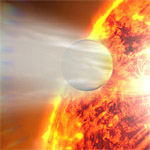
An international team of astronomers using data from NASA’s Hubble Space Telescope has made an unparalleled observation, detecting significant changes in the atmosphere of a planet located beyond our solar system.


The Hubble Space Telescope has discovered a planet, HD 189733b, that is losing some of it’s atmosphere every time a solar flare occurs. Credit: NASA GSFC

The scientists conclude …

Read the rest of this article

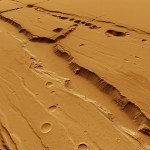
By studying rocks blasted out of impact craters, ESA’s Mars Express has found evidence that underground water persisted at depth for prolonged periods during the first billion years of the Red Planet’s existence.


The large 25 km-diameter crater in the foreground of this High Resolution Stereo Camera (HRSC) perspective view has excavated rocks which have been altered by groundwater in …

Read the rest of this article

Mars

A recent workshop conducted for NASA by the Lunar and Planetary Institute (LPI) in Houston, marked a key step in the agency’s effort to forge a new Mars strategy in the coming decades. A report that summarizes the wide range of cutting-edge science, technology and mission concepts discussed is available online.


NASA’s Mars Odyssey spacecraft passes above Mars’ south pole …

Read the rest of this article


Via: bpclaims.us

Read the rest of this article

AAVSO AAVSO Alert Notice 462
Monitoring of J1407 for next extrasolar ring system transit
June 26, 2012

Dr. Eric Mamajek (Cerro Tololo Interamerican Observatory and University of Rochester) has requested AAVSO observers’ assistance in monitoring the young star 1SWASP J140747.93-394542.6 to help determine the eclipse behavior related to a transiting ringed substellar companion.

This observing campaign begins now and continues until …

Read the rest of this article

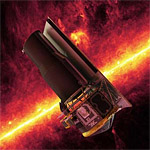
Seeing is believing, except when you don’t believe what you see. Astronomers using NASA’s Hubble Space Telescope have found a puzzling arc of light behind an extremely massive cluster of galaxies residing 10 billion light-years away. The galactic grouping, discovered by NASA’s Spitzer Space Telescope, was observed as it existed when the universe was roughly a quarter of its current …

Read the rest of this article

Turbulent jet streams, regions where winds blow faster than in other places, churn east and west across Saturn. Scientists have been trying to understand for years the mechanism that drives these wavy structures in Saturn’s atmosphere and the source from which the jets derive their energy.

In a new study appearing in the June edition of the journal Icarus, scientists …

Read the rest of this article

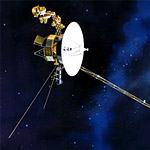
For nearly 35 years, NASA’s Voyager 1 probe has been hurtling toward the edge of the solar system, flying through the dark void on a mission unlike anything attempted before. One day, mission controllers hope, Voyager 1 will leave the solar system behind and enter the realm of the stars—interstellar space.

That day may be upon us.


At the edge …

Read the rest of this article

Progress continues with Planetary Resources, the private syndicate that proposes to mine asteroids in the near future for rare metals. Here’s their latest communication:

We’ve been working our tails off at Planetary Resources planning our initial launches of our first spacecraft.

We call these first Asteroid finding spacecraft Arkyd Series-100 (next email we’ll tell you where the name ‘Arkyd’ comes …

Read the rest of this article